Introduction
A bad sauna bench doesn’t announce itself. It just slowly ruins the session.
You start shifting every two minutes because the edge digs into your thighs, your feet feel weirdly cold, and the whole room has that damp, “why won’t this dry out?” smell that says the wood is losing a quiet war against heat cycles and wet bodies.
And the funniest part? People blame the heater. Or the stones. Or “that one draft.” When a lot of the time, the real culprit is the thing you’re sitting on.
A better sauna bench isn’t a decorative carpentry project. It’s a heat-and-body interface. Get it right and the room feels hotter (without actually being hotter), dries faster, and stays pleasant for years instead of turning into a splintery sponge.

Why Sauna Bench Design Is a Core Part of Sauna Performance
Bench height and heat efficiency
Heat stratifies. Always has, always will. So bench height is basically you choosing whether you want “sauna heat” or “warm room with spicy air near the ceiling.”
Finnish design guidance is blunt about it: the top bench should sit roughly 100–120 cm below the ceiling so bathers stay in the good heat zone.
If you prefer inches and like rules you can actually build from, a common builder target is about 43–44″ from the ceiling down to the top bench—because it puts your head where the heat (and löyly) live, not down in the cooler layers.
Ceiling height ties into this more than most people want to admit. Finlandia Sauna points out that an 8′ ceiling wastes heat and can leave the bench/head zone noticeably cooler; their charts show how much temperature can drop at bather level when the ceiling is too high.
So yeah—bench height isn’t “comfort.” It’s performance.
Ergonomics and long-session comfort
Let’s talk about the part nobody posts on Instagram: pressure points.
A bench can be “beautiful” and still feel like sitting on a 2×4 after ten minutes. The fixes are not mystical:
- Depth matters.Many kit and plan sets land around 20″ deep for the top bench and ~16″ for the lower, which is enough for most adults to sit without feeling perched.
- Back support matters.Even a simple backrest changes how long people can stay relaxed—because you stop holding yourself upright like you’re waiting at the DMV.
- Tiered benches matter.Not everyone wants the same heat. A two-tier layout gives choice: upper for full heat, lower for “I’m easing into it.” Smartmak calls out two-tier benches specifically on their commercial 4–6 person barrel model because it’s the simplest way to create multiple heat zones in one room.
Comfort isn’t softness. It’s geometry.
Safety and stability
Saunas are slippery. People stand up dizzy. Kids climb. Guests don’t know the room. And public saunas? It’s a revolving door of “first time, no idea.”
So: no sharp corners, no wobble, no surprises.
A few non-negotiables that separate serious bench builds from “weekend project energy”:
- Rounded front edgesso the bench doesn’t cut into legs (and doesn’t chip as fast).
- No exposed fastenerson the sitting surface. A common pro approach is fastening from underneath so the “good face” stays clean.
- Stable step geometryso getting up to the hot level doesn’t feel like a ladder at 190°F.
If the bench feels sketchy, people sit lower. And then your “sauna” becomes a lukewarm box.
Structural Design: How a Better Bench Supports Airflow and Durability
Load-bearing frame and long-term stability
Benches fail in boring ways: sagging, racking, loosening, squeaking, turning into a sponge.
The fix is also boring. Good.
- Build the frame like it’s a deck, not like it’s furniture.
- Use cross-bracingor solid blocking so repeated loads don’t loosen joints.
- Assume wood will move—because it will—through thousands of heat/humidity swings.
Modular bench frames are the grown-up move in high-use settings: swap a damaged slat run or a whole top section without tearing apart the room.
Slat spacing and ventilation
Here’s the part people get wrong: bench tops aren’t supposed to be a sealed platform. They’re supposed to breathe.
Spacing between slats is doing three jobs at once:
1) air flow for drying,
2) drainage for sweat/water,
3) reduced heat trapping under the seat.
One practical reference point: Saunafin suggests about 9/16″ spacing between bench boards.
Go tighter and the bench stays damp longer. Go wider and you start getting “why does this feel like sitting on ribs?” complaints, plus more dirt falling through.
And don’t ignore the underside. If the cavity under benches turns into a stagnant hot-humid pocket, you’re basically inviting funk to move in.
Fixed vs. modular benches in commercial settings
Fixed benches look “clean” on install day. Then real life shows up with mops, sweaty traffic, and the occasional biohazard situation nobody wants to describe.
For resorts, gyms, and shared wellness facilities, modular/removable benches usually win because they make it easier to:
- clean under and behind,
- inspect for wear,
- replace parts without downtime drama.
That’s not luxury. That’s operations.
Bench Design as Part of the Whole Sauna System (Barrel Sauna Example)
Space efficiency in curved environments
Barrel saunas, especially the popular barrel sauna outdoor models , are not rectangular rooms with cute curves. They’re cylinders. That changes everything.
Put straight benches inside a barrel and you create dead zones—awkward gaps that waste seating, interrupt air movement, and make the room feel smaller than it is.
Curved bench lines (or bench faces that actually follow the arc) use the envelope you paid for. More usable seat length, fewer weird corners, less “why are my knees in the aisle?” energy.
If you’re shopping systems, start at the category level and look at how the manufacturer treats the shape. Smartmak’s barrel lineup leans into the barrel form for heat circulation and layout, not as a visual gimmick.
Heat circulation and seating layout
In a barrel, the walls curve back down toward you. That matters because it changes how hot air rolls and returns.
Smartmak’s product pages spell this out plainly: the barrel shape is designed to promote efficient heat circulation, and the 4–6 person outdoor wooden barrel steam sauna calls out two-tier benches to let users choose hotter/cooler zones within the same footprint.
So when you look at something like Smartmak’s 4–6 person outdoor wooden barrel steam sauna, the bench layout isn’t “added later.” It’s part of the thermal idea of the whole unit. Here’s the reference page: Best 4–6 Person Outdoor Wooden Barrel Steam Sauna Supplier.
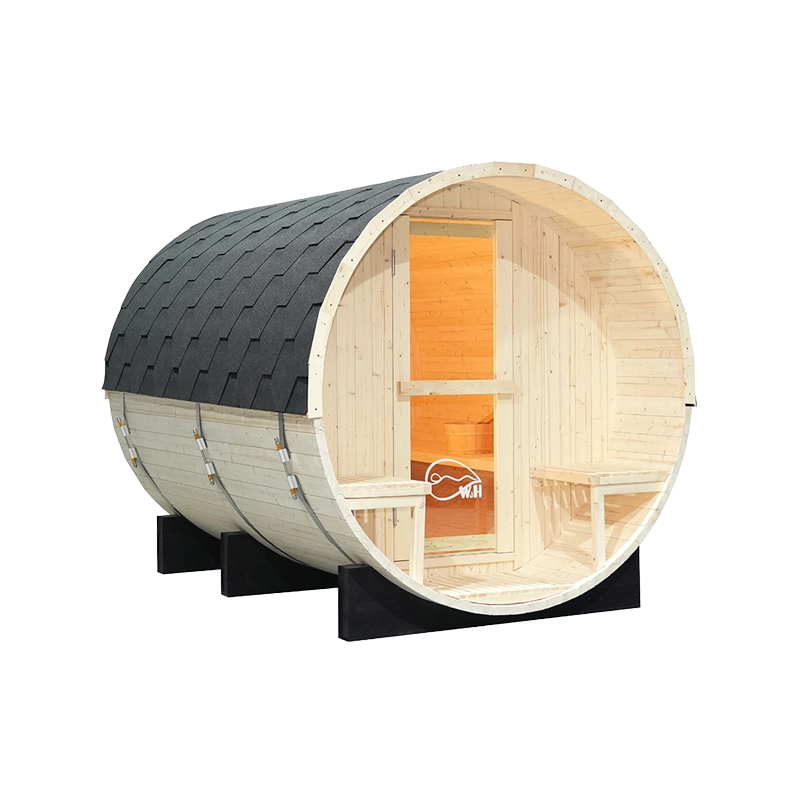
And yes, it shows up in user experience fast: faster warm feel, fewer cold-feet complaints, more consistent sessions across different body types.
B2B value of integrated bench design
If you buy for resale, hospitality, or multi-unit installs, bench design stops being “nice.” It becomes a reliability filter.
Benches designed as part of the sauna system mean:
- Lower installation risk:fewer on-site improvisations, fewer “we had to shim it” fixes.
- More consistent user experience:guests get the heat they expect because seating lands in the right zone.
- Fewer after-sales headaches:less warping, less wobble, fewer complaints about comfort and cleanliness.
That’s why buyers who treat benches as an engineered component (not a carpentry afterthought) tend to have fewer problems later. This is also why it’s worth browsing Smartmak’s broader Barrel Sauna category before you spec anything—shape, seating, and heat behavior are tied together.
Materials That Make a Sauna Bench Better Over Time
Wood selection and thermal comfort
A bench wood choice is basically a skin-contact decision.
Good bench woods share a few traits: they don’t get scorching-hot to the touch, they behave through heat cycles, and they don’t ooze resin.
Quick, practical examples:
- Aspengets picked a lot for benches because it “stays cool” and is typically resin-free.
- Western Red Cedaris a common North American choice; suppliers emphasize its comfort in high heat and resistance to moisture/decay.
- Canadian Hemlockis often sold as more odor-neutral and resistant to warping/splitting through repeated cycles.
No wood is magic. But some woods forgive abuse better than others.
Surface finishing and skin contact
Your skin is the finish test.
If it snags a towel, it’ll snag you. If it feels fuzzy, it’ll stay dirty. If it’s coated in mystery chemicals, it’ll smell weird when hot—and nobody wants to inhale that for 30 minutes.
The sane approach is simple:
- sand smooth,
- ease edges,
- keep interior surfaces basically natural (or use sauna-safe, heat-rated products only).
Smartmak’s own panoramic barrel sauna page even notes that interior surfaces are left natural, with exterior oiling as the maintenance play—because the inside is where people breathe and sweat.
Maintenance and lifecycle considerations
Commercial saunas run daily. That changes the math.
Durable materials (and replaceable parts) reduce how often you have to shut down a room, pull carpentry, and deal with guest complaints. Even if you’re not “commercial,” your future self will still appreciate benches that don’t turn into a maintenance hobby.
If you want more on how people actually use these spaces—flow, sequencing, the real-world rhythm—Smartmak’s blog post on sauna & steam room protocols is a solid companion read.
Conclusion
A better sauna bench isn’t about looks. It’s about whether the room works the way it should.
Get the height right and you stop wasting heat near the ceiling.
Get the geometry right and people stay longer without fidgeting.
Get the airflow and structure right and the sauna dries out faster and ages slower.
And if you’re buying for business—wholesale, resort, gym, multi-unit installs—bench design is a quiet predictor of how many support tickets you’ll deal with later.
Choose systems where seating is engineered as part of the whole. Your customers won’t write you a thank-you note. They’ll just… stop complaining. Which is the real prize.
FAQ
What is the ideal height for a sauna bench
A common rule is to work from the ceiling down, not from the floor up: keep the top bench about 100–120 cm (40–48″) below the ceiling so bathers sit in the best heat layer.
How deep should a sauna bench be for comfort?
Many standard layouts land around ~20″ for the top bench and ~16″ for a lower bench, which is enough to sit without feeling perched.
What wood is best for sauna benches?
If you want low-drama, skin-friendly options: Aspen is commonly recommended for benches because it stays cooler to the touch; cedar is widely used for comfort in high heat and moisture resistance; hemlock is often chosen for stability and a more neutral smell.
Are removable sauna benches better than fixed ones?
In shared or commercial settings, often yes—because cleaning and replacement are simpler. In private saunas, fixed can be fine if airflow and access underneath aren’t sacrificed.
What spacing should sauna bench slats have?
A practical benchmark is around 9/16″ spacing between boards—enough to breathe and drain without feeling like you’re sitting on a ladder.