Introduction: A Useful Sauna RFQ Connects Specifications with Order Conditions
An RFQ, or Request for Quotation, is a document used for competitive procurement. The purpose is to invite manufacturers to submit their price bids. It is fully applicable to standardized products and customizable sauna units.
Simply sharing the product photo or a target product quantity can lead to problems later. There are many important variables that are left unanswered without a proper document clearly stating business requirements. Often these outstanding issues relate to shipment challenges and design specifications. These problems can also impact contractual agreements.
A well-organized RFQ ensures that businesses acquire accurate and actionable price quotes. This structured approach allows hotel developers to easily compare similar items. It also helps equipment distributors to avoid initial estimates padded with hidden cost buffers.
Aligning the following elements eliminates delays during factory order release:
- Timber Grades
- Heater Sizing
- Electrical Safety Standards
- Minimum Order Quantities (MOQ)
- Production Lead Times
The primary objective for B2B buyers is establishing a transparent communication framework. This prompts manufacturers to disclose precise unit pricing upfront. It also clarifies setup fees and locks in reliable delivery schedules.
1. Specify What the Supplier Is Actually Being Asked to Quote
1.1 Describe the Purchasing Scenario and Destination Market
State the purpose of the query, whether it’s for private-label retail or wholesale. Some purchasers might be searching for units for a small resort, while some may be trying to start a commercial gym. Determine the operational duty cycle. For example, low-frequency private home use and continuous high-turnover commercial spa activities.
Identifying the target country/municipality is important. The location information will help in determining the local electrical code requirements for the sauna unit. Electrical standards vary greatly depending on the market.
North American installations are subject to demanding ETL/UL listings for dedicated 220V/240V single-phase or three-phase circuits. Conversely, locations in Europe or Oceania will require CE compliance, supported by RoHS approvals and SAA certifications.
Detail site-specific weather parameters that dictate timber species and hardware selection:
- Heavy Snow Loads
- Coastal Salt Spray
- Extreme UV Exposure
1.2 Establish the Product and Technical Baseline
Provide explicit cabin dimensions. Common footprints are 1800mm x 1800mm. Another standard is 1800mm x 2400mm. State capacity ratings clearly. Some units fit 2–4 adults, while some larger models accommodate 4–6 users.
Specify Grade-A kiln-dried timber options:
- Canadian Red Cedar
- Canadian Hemlock
- Nordic Spruce
Note: Traditional outdoor steam saunas rely on Canadian Red Cedar staves with a 38.5mm–42mm wall thickness. The design utilizes a ball-and-socket profile. The timber’s natural thujaplicins resist decay. Meanwhile, the barrel’s curved geometry reduces internal volume by approximately 23%. This accelerates heat-up times. It also circulates steam without ceiling heat stratification.
State the preferred thermal route. This could be a traditional electric rock stove, a wood-burning chimney stove, or full-spectrum far-infrared carbon panels.
Request for Digital Soft Touch Panels. They are offered with either an internal or external mount. Make sure they have built-in thermostatic sensors. Additions like Bluetooth audio should be noted. Chromotherapy LED arrays are another popular request.
Require documentary submittals prior to sample sign-off. These include:
- Factory CAD Architectural Drawings
- Exploded Assembly Diagrams
- Structural Load Calculations
Note: Improve heat dissipation by replacing insulated wood walls with a panoramic back wall made of 8–10 mm explosion-proof tempered glass. Multiply the heater’s output by 1.2 to 1.5 times for rapid warm-up times. As a result, failure of thermal recovery is also prevented.
1.3 Define the Supply Scope and Delivery Requirements
Clarify the exact quotation scope by identifying included items:
- Sauna cabin
- Heater stove
- Guardrail
- Vulcanite sauna rocks
- Wooden bucket with ladle
- Thermohygrometer
- Sand timer
CKD flat-pack packaging should be in strong-quality 5-layer corrugated cartons. Include palletized strapping for maximum loading density of containers. Name the required trade terms. Common examples include FOB. Others use CIF. DDP is also widely accepted. Detail the unloading responsibilities at the destination.
Define private-label requirements clearly. You might need laser-engraved door handles. Branded thermometer housings are another common request. Custom carton printing should also be specified. Separate essential baseline items from optional add-ons. Popular additions include bitumen roof shingles. Front porches are also frequently requested.
Premium outdoor barrel saunas utilize double tongue-and-groove stave joinery. This is combined with 304 stainless steel tension bands. The result is a mechanical weather seal. This seal expands naturally with steam humidity. It successfully avoids chemical sealants that off-gas under high temperatures.
2. Understand How Order Structure and Customization Affect Sauna MOQ
2.1 Ask Which Items the Minimum Quantity Applies To
Clarify how minimum order thresholds are applied. They might govern the total master shipment. Sometimes they apply to individual cabin models. In other cases, they are tied to specific timber selections. Request separate MOQ limits for standard catalog SKUs. Compare these against custom-milled dimensions. The same applies to specialized panoramic glass back walls.
Determine if higher minimum batch runs apply to packaging or branding elements. This affects custom-printed master cartons. It also impacts color user manuals alongside laser-etched glass doors. Ask whether combining various SKUs satisfies total container MOQs. Evaluate how specialized wood requests affect factory lumber purchasing minimums.
Factories order raw timber in bulk kiln-dried runs. Opting for standard Grade-A Canadian Hemlock or Red Cedar allows lower unit MOQs. Exotic or rare timber profiles trigger raw-material mill minimums. This dynamically scales first-order batch sizes.
2.2 Match the First Order to the Purpose of the Purchase
Evaluate initial single-unit sample orders. These are designed strictly for physical quality evaluation. They also serve showroom display purposes. Photography is another primary use case. Define partial container pilot orders. These test market acceptance across regional retail networks.
Clarify why individual sample units incur higher unit costs. Understand the setup charges compared to full container production runs.
Confirm whether factory floor pre-drilled sample units can ship in 3–5 days. Contrast this with standard 25–30 day bulk manufacturing schedules. Use pilot orders to verify assembly instructions. They also help test hardware tolerances. Furthermore, they smooth out destination customs clearance before committing major capital.
Shipping a single flat-pack sauna via air freight or LCL exposes fragile 8mm glass panels to handling risks. This erodes profit margins. Full container shipments reduce landed freight overhead per unit by up to 60%. They also protect glass components effectively.
2.3 Evaluate MOQ Alongside the Full Cost of the Order
Request an itemized cost breakdown. This should isolate one-time CNC tooling from the base cabin price. It must also separate glass cutting molds. Logo laser printing fees should similarly be itemized. Solicit tiered quotation breaks to identify volume cost-efficiency thresholds.
Balance the lower unit price achieved through higher volume purchases against operational realities. These include capital lockup. Warehouse storage fees also play a role. Seasonal demand shifts must be factored in.
Ensure the initial quote covers spare part kits. Extra staves and replacement heating elements minimize downtime claims. Negotiate structured payment milestones to maintain commercial leverage.
Standard barrel saunas built with precision CNC-milled 38.5mm staves avoid setup surcharges. Introducing non-standard stave radii forces retooling of the milling line. Custom door cutouts have the same effect. This requires cost amortization over a larger MOQ to remain economically viable.
3. Define Custom Sauna Requirements Before Approving Production
3.1 Separate Configuration Changes from Design Changes
Classify simple swaps among catalog options as minor configuration updates. An example is selecting an electric 6kW stove over a wood heater. Recognize that major re-engineering happens elsewhere. Altering internal bench elevations falls into this category. Expanding cabin length is another major change. Modifying glass wall coverage also triggers re-engineering.
Specify private-label integrations individually:
- Laser-engraved wood marks
- Silkscreened glass logos
- Customized digital boot screens
- Translated manuals
Request confirmation on how structural or glazing changes impact the unit. Verify the effect on heater kW requirements. Check the impact on thermal insulation. Confirm safety clearances are maintained. Require updated CAD shop drawings before releasing modified designs to the factory floor. Pre-production digital renderings should also be approved.
Factory-milled air grilles are incomplete without a coordinated mechanical airflow strategy. Fresh-air supply vents must enter directly beneath the electric heater. Exhaust vents must sit diagonally opposite under the upper bench. This prevents thermostats from registering false temperature readings.
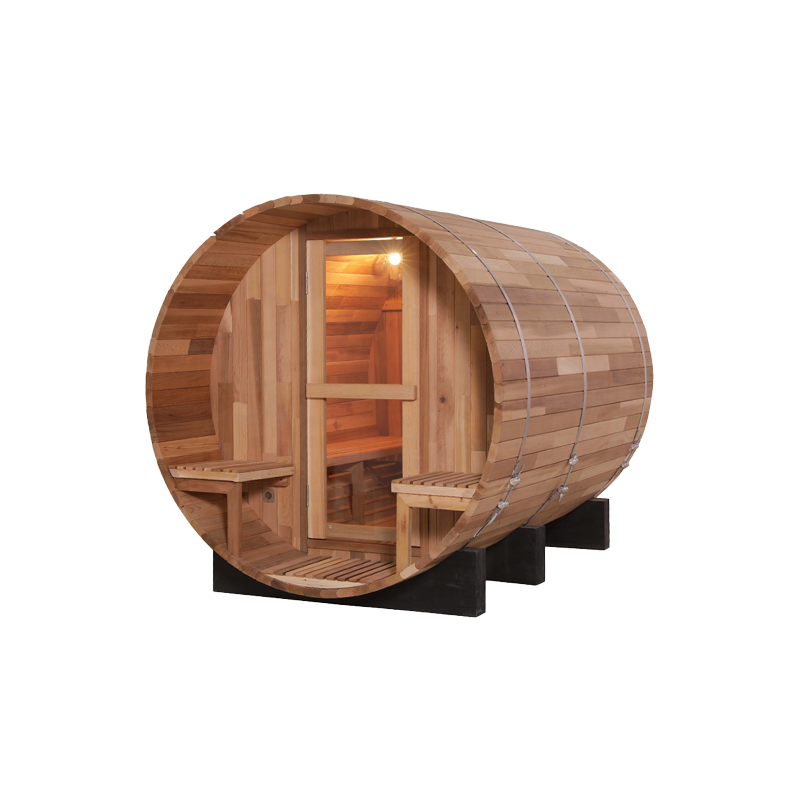
3.2 Use the Smartmak SMT-1818P Low MOQ Custom Outdoor Traditional Dry Steam Barrel Sauna as an RFQ Starting Point
Buyers in B2B can change the way standard barrel platforms work without having to pay for full custom engineering. Use the Smartmak SMT-1818P Low MOQ Custom Outdoor Traditional Dry Steam Barrel Sauna as your starting point for quick sourcing. This model makes it easy to change the layout of the benches or add rear panoramic glass walls. First, set the base price for regular Canadian Hemlock or Pine. Then, ask for higher prices for Grade-A Red Cedar or wood that has been heated and cooled.
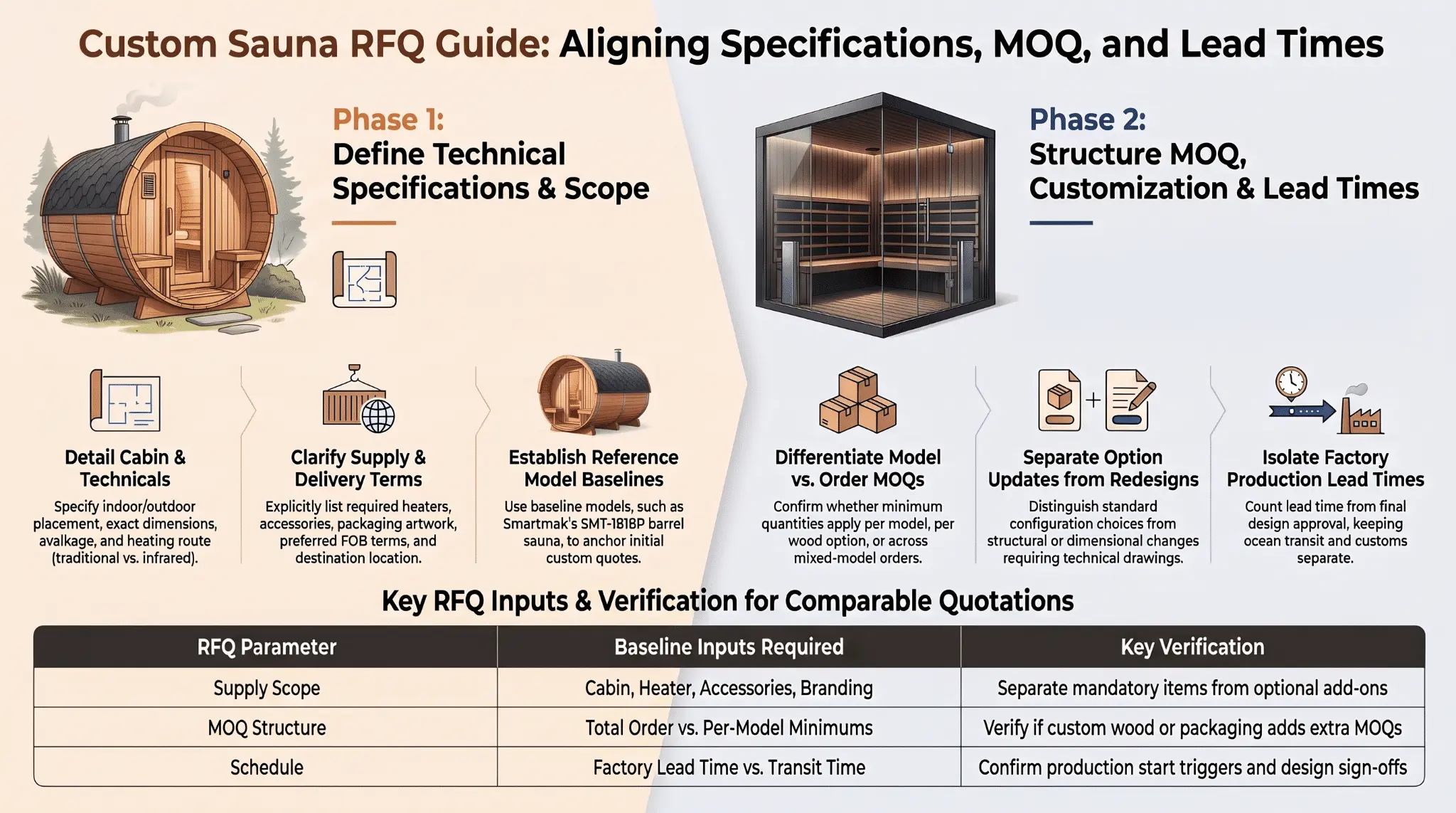
Remember that until you get an official confirmation in the form of a final written quotation, all of the supplier’s specifications should be taken as provisional. This rule is the same for production lead times, minimum order quantities, and choosing specific parts. To get accurate container-load prices that are tailored to your market, send Smartmak a detailed quote request using the structured matrix below to make sure they understand exactly what you need.
Procurement Field | Baseline Specification | Buyer Customization Requirement | Status |
Product Form | Outdoor Barrel Sauna (1800mm x 1800mm) | Extended 1800mm x 2400mm | Fixed Requirement |
Timber Material | Kiln-Dried Canadian Hemlock | Grade-A Canadian Red Cedar | Fixed Requirement |
Heating System | 6kW Electric Stove (220V/240V) | 6kW SAWO Stove + Chimney Adapter | Preference |
Glazing Specs | 8mm Tempered Glass Door | 180° Panoramic Rear Wall | Fixed Requirement |
Destination Specs | North American / European Market | Dedicated 30A circuit; ETL, CE | Fixed Requirement |
Precision-milled 38.5mm staves featuring an interlocking ball-and-socket profile allow contractors to complete assembly within 4 hours. This requires no specialized power tools. It drastically reduces field labor complaints for equipment distributors.
3.3 Establish an Approval Baseline for the Production Order
Lock all approved dimensions into a frozen, signed submittal package. Timber grades must be finalized. Electrical schematics should be locked in. Branding files need the same treatment.
Establish whether production release requires specific verification methods:
- Physical material sample swatch
- 3D CAD drawing confirmation
- Golden pre-production unit
Enforce a strict change-management procedure. Any mid-production modification reopens lead time reviews. It also triggers pricing reassessments. Mandate a 100% pre-shipment factory inspection. This must cover electrical safety. It should verify the timber finish. Door swing alignment requires testing. Packaging integrity must also be confirmed. Require written approval for any material substitutions prior to container packing.
Quality control for commercial sauna builds requires inspecting hidden assemblies. You must verify continuous vapor barriers. Service cavities need checking. Unpunctured insulation seals must be confirmed. All this happens before timber cladding conceals the structural framing.
4. Check Lead Time and Quotation Details Before Placing the Order
4.1 Define When the Production Clock Starts and Ends
Confirm that the manufacturer clocks in the production timeline after receiving the initial deposit. Signing off on final CAD drawings is the other mandatory trigger. Distinguish factory manufacturing completion from international ocean transit. Port customs clearance adds entirely separate timelines.
Verify whether the supplier’s lead-time quote refers to factory working days. Some use calendar days instead. Factor in regional factory closures. These stall raw material sourcing. Assembly lines also shut down during these periods.
Define production sign-off based on strict deliverables. Factory QA testing must be completed. Receipt of container loading photographs is equally important. Unresolved artwork files freeze factory production queues. Delayed electrical voltage confirmations cause similar bottlenecks. These delays happen even after deposit clearance, making early technical lock-in essential.
4.2 Plan Backward from the Required Arrival Date
Calculate target order placement by mapping backward from the destination project opening date. Following a similar backward mapping technique for commercial retail launches.
Allocate 20 to 40 days for the logistics chain. Maritime shipping takes the bulk of this time. Port congestion adds unpredictable delays. Include margin for unexpected shipping delays. Also, leave a buffer for extreme weather disruptions. Vessel customs clearance also adds to the time. Inland drayage finishes the leg. Reserve additional weeks for sample evaluations. CAD drawing revisions take time. Pre-payment banking transfers also need scheduling.
Prepare your site while the sauna is in transit:
- Pour Level Concrete Foundations
- Install Electrical Sub-Panels
- Route Necessary Drainage
Outdoor barrel saunas are sensitive to their foundational alignment. If it’s placed on an uneven surface, the structural integrity will be compromised. It can cause the staves to bend, eventually binding the door and allowing moisture to seep in through roof seams.
It’s vital to prepare the installation site and ensure that it’s completely leveled. Buyers should require either a poured reinforced concrete pad or heavy-duty structural decking to adequately sustain the unit’s weight and maintain tight dimensional stability.
4.3 Compare Supplier Quotations on the Same Basis
Ensure all factory bids are evaluated against identical baselines. Timber grades must match. Wall thicknesses need to be identical. Heater brands should align. Packaging specifications require exact pairing.
Compare critical commercial terms systematically:
- Quote Validity Windows
- Payment Milestone Stages
- Warranty Terms
- Currency Risks
Check whether lower quotes secretly omit critical items. Vulcanite sauna rocks are often dropped. Chimney flashings might be missing. Touch controllers are frequently downgraded. Wooden accessory kits can also disappear. Use the standardized review matrix below to compare supplier proposals side-by-side:
Evaluation Parameter | RFQ Target Requirement | Supplier A Response | Supplier B Response | Decision Status |
Model Footprint | 1800mm x 1800mm | 1800mm x 1800mm | 1750mm x 1750mm | Supplier B undersized. |
Timber Thickness | Canadian Red Cedar (38.5mm) | Canadian Red Cedar (38.5mm) | Canadian Hemlock (35mm) | Supplier B uses cheaper wood. |
Glazing Specs | 8mm Tempered Glass | 8mm Tempered Glass | 6mm Standard Glass | Supplier B fails safety baseline. |
Heater Output | 6kW Certified Electric Stove | 6kW SAWO Stove | Unbranded 4.5kW Stove | Supplier B is underpowered. |
Production Time | 25 Working Days | 25 Working Days | 40 Calendar Days | Supplier A offers a faster turn. |
Note: A lower supplier headline quote often reflects hidden compromises. They might substitute 38.5mm Grade-A Red Cedar with 35mm Hemlock. Swapping 8mm safety glass for thin 6mm glass is another tactic. This increases heat loss. It severely compromises user safety. It ultimately drives higher warranty claim rates.
Conclusion: Turn the RFQ into a Clear Purchasing Baseline
Achieving procurement success requires connecting detailed technical specifications with clear order parameters. Focus on timber species. Verify stave joinery. Lock in heater output. Guarantee glass safety. Resolving MOQ thresholds before issuing deposits prevents costly disputes. Customization surcharges need upfront clarity. Hidden tooling fees must be exposed. Lead-time triggers require precise definition.
B2B buyers should maintain version-controlled RFQ submittal sheets. Comparative evaluation matrices streamline vendor management perfectly. Prepare a comprehensive custom sauna RFQ detailing target delivery dates. Outline destination market regulations. State your required timber species. Detail your custom OEM branding requirements to secure accurate, commercial-grade pricing tailored to your specific market.
FAQ
What is the MOQ for custom sauna orders?
Minimum order quantities vary based on the customization depth. Baseline models start at low MOQs of 1 to 5 units. Custom-milled dimensions push this MOQ higher. One of the reasons is that custom-printed cartons often require full 20ft container quantities.
Can different sauna models be combined to meet the MOQ?
Yes, commercial buyers can combine different catalog SKUs to satisfy total container volume requirements. You might mix outdoor cedar barrel steam saunas with custom infrared sauna cabins. Adding cold plunge tubs is another great way to fill the container.
What is the difference between OEM and ODM sauna orders?
OEM applies buyer branding to an existing factory design. These are readily available designs with a mature manufacturing process. Factories allow minor feature swaps to these designs. ODM builds bespoke cabin shapes entirely from scratch. Unique dimensions and completely custom heating architectures fall under ODM.
When does the production lead time for a sauna order start?
Factory lead time commences strictly after the initial deposit clears. Final CAD shop drawings must also be signed off by the buyer. Artwork files require approval. Electrical specifications need final confirmation.
Does sauna lead time include shipping and customs clearance?
No, factory production lead time strictly covers manufacturing. Ocean transport adds massive timelines. Customs clearance adds more delays. Final port drayage requires scheduling. Expect an additional 20 to 40 calendar days for transit alone.