
Shipping a Wooden Sauna Cabin internationally is more complicated than just putting the simple product into a carton and sending it out. A sauna cabin may include large wall panels and roof. There are also base components, benches, glass, hardware, electrical accessories and smaller installation parts. These components may pass through several handling stages before they reach the buyer. That makes the packing and packaging method an important part of the order. It should not be something to consider only after manufacturing is complete.
For an overseas buyer, the main question is simple: Will the wooden sauna and its components arrive organized, undamaged, protected and easy to check?
The packing plan should match the actual cabin configuration. It should keep components from moving unnecessarily inside their packages. The buyer should be given enough information to identify and inspect the shipment when it arrives. Smartmak’s Wooden Sauna Cabins packaging policy for international shipping provides a useful example of how these objectives are achieved.

1. Planning the Packages Around the Cabin Configuration
The first step to understand is to know what is being shipped in the package.
A sauna cabin is made up of several different types of components. Wall panels may need different protection. Benches or smaller accessories may require different safety. Glass requires separate fragile attention while electrical parts and hardware need to remain easy to identify.
The correct carton size and packing method therefore depend on the model and in what form the cabin is being supplied.
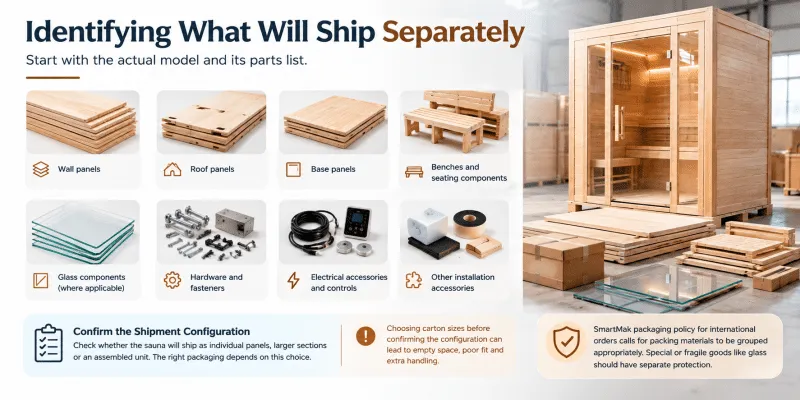
Identifying What Will Ship Separately
Start with the actual model and its parts list.
Separate the main cabin components into groups such as:
- Wall panels
- Roof panels
- Base panels
- Benches and seating components
- Glass components, where applicable
- Hardware and fasteners
- Electrical accessories and controls
- Other installation accessories
The buyer should also confirm whether the sauna is being shipped as individual panels, larger sections or an assembled unit.
This matters because packaging designed around flat panels will be different from packaging for a larger assembled section. If you choose the carton sizes before confirming the shipment configuration, it can create unnecessary empty space and poor fit. This would in turn lead to additional handling problems.
Smartmak packaging policy for international orders of Wooden Sauna Cabins calls for packing materials to be grouped appropriately. This includes special or fragile goods like glass should have separate protection.
Matching Each Package to the Order
When all of the parts are known, they should be matched against the dispatch information.
Before packing all model numbers and quantities should be checked. The Smartmak packaging procedure specifically calls verification of the model and quantity against the dispatch note.
This is particularly important for multi-box sauna shipments.
What if you receive six or eight cartons several weeks after the order left the factory. Without clear identification, it becomes difficult to know which carton contains the benches. Which contains the roof panels and which contains smaller installation parts.
A contents list inside each carton can make the things much easier. If components from one Wooden Sauna Cabin are split between several packages, each package should clearly identify what it contains.
For B2B buyers, this can help in creating a simple receiving trail. The shipment can be checked against the purchase order and packing list before the cartons are opened and distributed around the installation site.
2. Protection of the Components Inside Each Carton
After deciding what goes into each package, the next concern is how those components are positioned and separated.
During handling and movement the large wooden panels can rub against other components. Corners and edges also require some extra attention. This is because they are more exposed than flat surfaces.
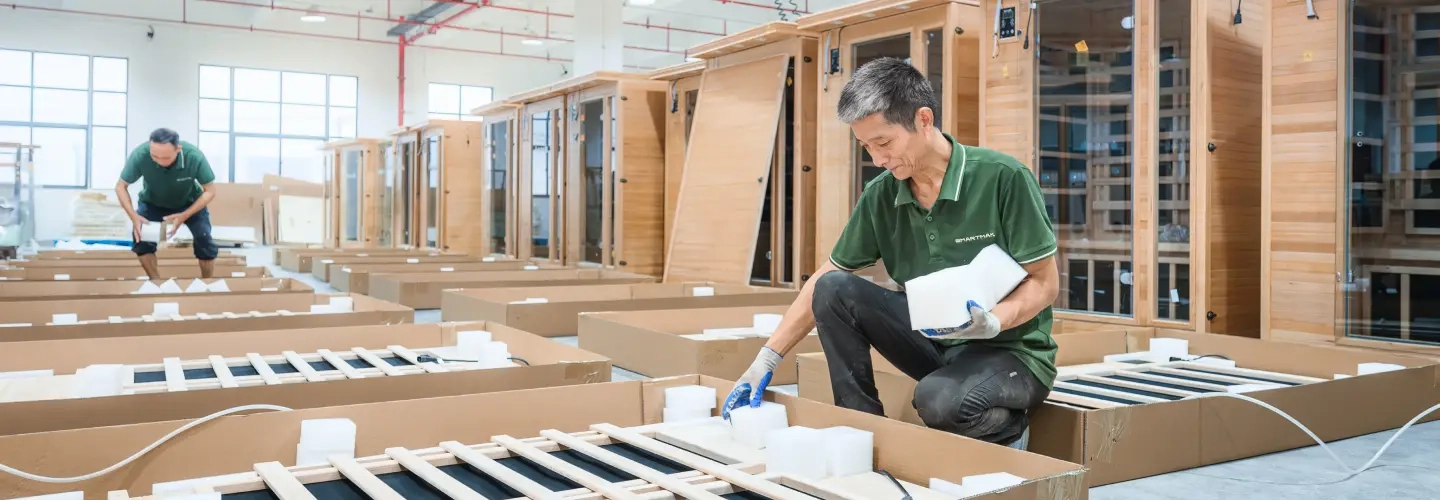
The packaging policy of Smartmak Wooden Sauna Cabin specifies cushioning, separation and protection between products inside cartons.
Prevention of Contact and Movement
The basic principle is straightforward. None of components should not be left loose inside a carton.
As an international buyer you can ask a supplier to explain the protection used for your specific model. It should not be assumed that the same packaging material specification applies to every sauna cabin.
- Cushioning should be placed between vulnerable components and the carton walls. Sometimes several items share a single package or carton. In such cases, foam or corrugated board can be used to separate them.
- Corners and edges should be given particular attention. The contact in these areas can affect finished surfaces.
- At Smartmakthe foam pieces are used to separate and protect sauna panels inside shallow cartons. The specific foam grade, thickness, density or impact rating can be different depending on the component being packed in the carton.
- Glass, when included, should also be treated separately from ordinary wooden panels. The Smartmakpackaging policy specifically identifies glass and other fragile goods for separate protection.
- Another simple point is carton fit. A carton should accommodate its contents without excessive empty space. Too much unused space can allow components to shift, while an unsuitable carton can make packing and handling more difficult.
Checking the Finished Package
The inspection should not stop once the components have been placed inside.
Before a carton is closed, check for:
- Loose contents
- Damaged carton material
- Bulging sides
- Incomplete accessory sets
- Missing components
- Poorly positioned protective material
The Smartmak packaging procedure for Sauna Cabins calls for finished packages to be neat and firm. They should be without looseness, bulging or uneven surfaces. It also requires that the outer packaging should be clean and undamaged.
Hence, a second accessory check is useful.
Small items such as hardware, controls or installation parts are often easily overlooked when a shipment contains many larger components. As per the Smartmak in-process inspection checklist accessories are to be checked against the relevant task sheet and then checked again during packing.
For an overseas buyer, that second check can be just as important as the physical protection of the larger panels.
3. Smartmak Example: Lid-and-Base Cartons for Wooden Sauna Cabins
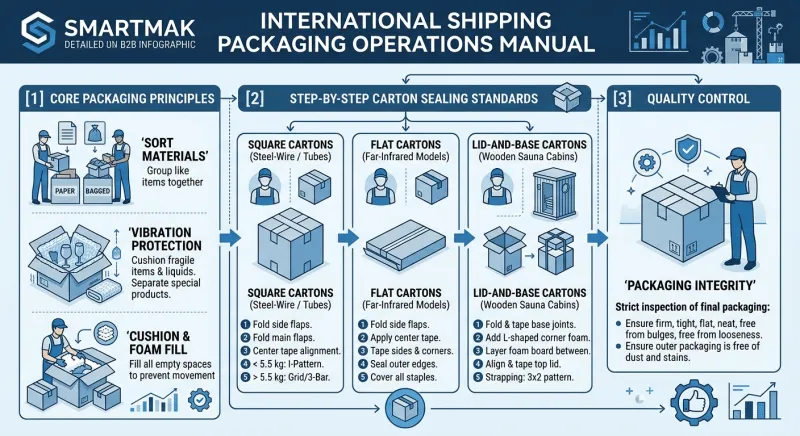
Smartmak’s packaging policy for sauna cabins provides a documented example of a lid-and-base carton used for Wooden Sauna Cabins.
This is useful for understanding the packing sequence. However, it should not automatically be treated as the exact packaging specification for every Smartmak model or order.
The Documented Packing Sequence
The documented procedure starts with preparing the carton base.
- Foam board is placed under the product in an L-shaped foam protection. It is specially employed around corners and folds.
- Additional protective foam is placed between the different product layers.
- The product is then placed on the protected base. There is a separation repeated where multiple layers are packed.
- The lid is aligned with the base once the contents are finally positioned.
The next step of the Smartmak packing procedure is securing the carton with tape around the corners and selected sides. This is followed by straps.
- For a rectangular carton, the procedure specifies three straps along the long side and two along the short side.
- For a square carton, it specifies two in each direction.
The purpose of describing this sequence is not to propose that these materials or strap arrangements guarantee a damage-free shipment. It only shows how the Smartmak factory’s packing procedure is planned around separation, protection and securing the package.
As a buyer you should still confirm the exact procedure used for a quoted model with the supplier.
Carton Dimensions Are Model Dependent
Carton dimensions are not universal.
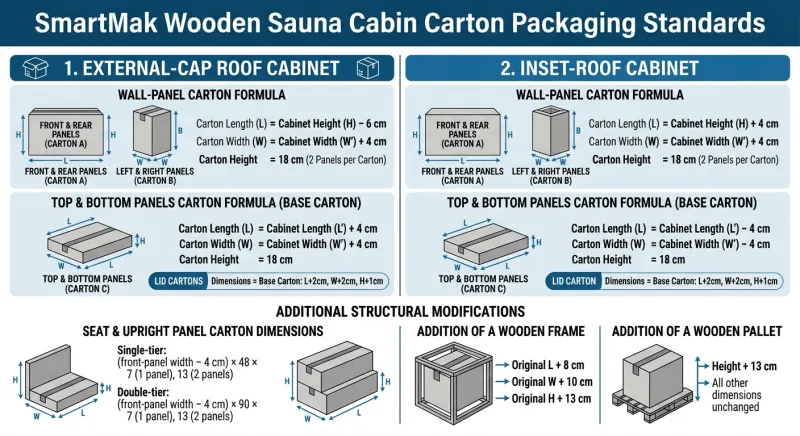
Smartmak’s carton standard gives different sizing rules depending on the cabin’s roof arrangement. This is because an external-cap roof and an inset roof pack differently.
As an example, for a 150 × 120 × 190 cm cabinet with an external-cap roof, the base-carton sizes come out to roughly:
- 184 × 154 × 18 cm for the front and rear panels
- 184 × 124 × 18 cm for the left and right panels
- 154 × 124 × 18 cm for the top and bottom panels.
These numbers are useful as a source example of how carton sizing scales with cabin dimensions. However, they are not final packed dimensions to hand to a freight forwarder.
A different model, a different roof style or the addition of a wooden frame or pallet all change the final numbers.
Some Orders Add a Wooden Case and Film Wrapping on Top
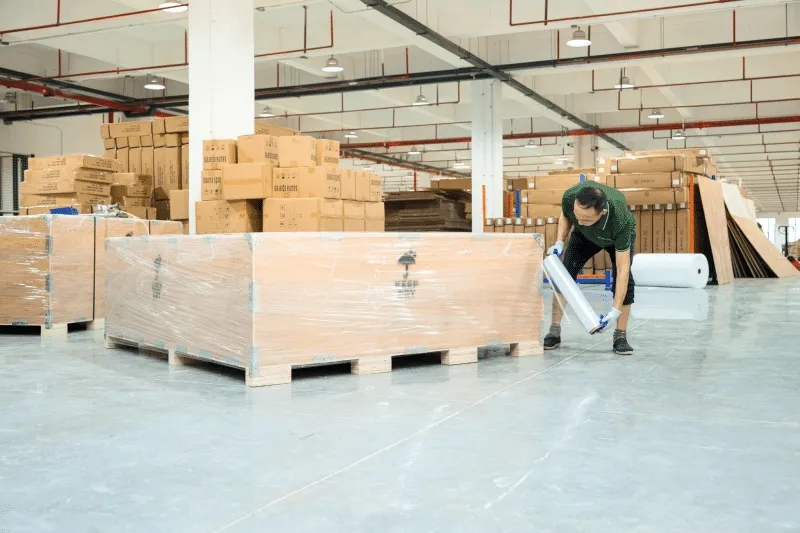
Beyond the carton itself, Smartmak’s packing process highlights that a further layer of outer protection can be added on some orders. The packed carton built into a wooden case, with stretch or wrapping film applied around the outside before it’s moved by forklift.
But that is only one packing option. It is not something guaranteed on every order.
A wrapped wooden case is a different (and typically sturdier) setup than a carton shipped on its own. So whether your specific order includes one and what the wrapping actually consists of, is exactly the kind of detail worth confirming in writing from the supplier rather than assuming from a photo of a different shipment.
Making It Useful for a B2B Buyer
For an importer or distributor, the most useful information is not simply a carton formula.
Before shipment, the B2B buyer should request the model-specific packing information.
Ask the sauna cabin supplier for:
- Packing drawing or packing specification
- Total number of packages
- Final external dimensions of each package
- Gross weight of each package
- Packed-order photographs
- Contents of each package
- Handling marks
- Any wooden frame or pallet details
- Outer wrapping details, if included
This is especially important for larger orders.
If a wooden frame, pallet or outer wrapping is required, have it included in the written order specification. Do not assume.
4. Preparation of the Shipment for Handover and Receipt
Good packaging is only part of the process.
The buyer also needs to know how the shipment will be identified, handled and checked after it leaves the factory.
Agreement on Transport and Unloading Details
Before dispatching the order, confirm the handling requirements for the actual packages.
Ask about:
- Package count
- Package dimensions
- Gross weights
- Handling marks
- Lifting or unloading requirements
- Access limitations at the destination
- How packages will be arranged for the booked transport
- Whether an order-specific loading plan is available
This becomes particularly important when large packages are being delivered to a residential project, warehouse, showroom or construction site.
The buyer should check the delivery location before the shipment arrives. Consider the available access, unloading area, doors, ramps and equipment that may be needed to move the packages safely to their storage or installation location.
It should not be assumed that a photograph showing a forklift handling a wrapped wooden case on the website establishes a universal forklift procedure or confirms the lifting capacity required for another shipment. Any provided handling footage provides context only.
Provision of a Practical Checking Trail for the Importer
The documents should make it possible to connect the shipment back to the purchase order.
Carton marks, packing lists and shipping documents should use consistent model and package information.
For example, if a cabin arrives in several cartons, the buyer should be able to identify which packages belong to that cabin and what each package contains.
At delivery, compare the actual package count with the shipping and packing documents.
Then inspect the visible condition of the packages.
If you see damaged cartons, opened packaging, crushed areas or other visible exceptions, photograph them before moving ahead with unpacking where practical. Record the package number and follow the damage or missing-parts process agreed with the supplier and relevant logistics parties.
This does not mean every issue will result in product damage. It simply gives the buyer a clear record if a problem needs to be investigated later.
Conclusion — A Packing Specification Belongs in the Order
International sauna packaging works on this best when it is planned around the actual product rather than treated as a standard box-sizing exercise. This means customized packaging.
Start by defining exactly what will shipped in the package. Then separate wall, roof and base panels from benches, glass, hardware and other accessories. Match quantities to the dispatch list. Then protect components inside the cartons with suitable separation and corner protection.
Smartmak’s packaging policy provides a good example of foam support, L-shaped corner protection, layered separation, lid closure, taping and strapping for Wooden Sauna Cabins. Its carton standards also show that package dimensions can change with the cabin configuration.
For buyers, the most important step is to turn these general procedures into an order-specific packing specification.
Before shipment, approve the package count, final dimensions, weights, contents, photographs and any additional packaging requirements in writing.
This is particularly valuable for distributors, project buyers and multi-unit orders.
FAQs
How can buyers check that all benches, hardware and electrical accessories are included?
You can ask for model-specific parts or packing list. Then compare it with the purchase order and dispatch note. If components are divided between multiple cartons, you should request a contents list for each package. The Smartmak packing procedure also calls for model and quantity checks against the dispatch information.
What packing photos or records should an overseas buyer request before shipment?
Request photos showing the packed order, package labels and the finished outer packaging. It is also useful to request the final package count, external dimensions and gross weights. For B2B orders, keep these records with the purchase order and shipping documents.
How should carton marks and packing lists identify a multi-box sauna cabin?
They should make it clear which model and package each carton belongs to and what the carton contains. This gives the receiving team a practical way to reconcile the shipment without opening every package immediately.
What unloading equipment and site access should be planned before delivery?
You should start with the final package dimensions and gross weights provided for the actual order. Then check the destination’s access route, unloading area and available handling equipment. If the shipment has unusual dimensions or access limitations, discuss the unloading arrangement before dispatch.
What should a buyer do if a carton arrives damaged or a component is missing?
Always record the package number and visible condition. You can do this by taking photographs of the issue and comparing the shipment with the packing list. Then follow the damage or missing-parts process agreed with the supplier and logistics provider.
Keeping a clear receiving record makes it easier to identify what happened and determine what needs to be resolved.