Introduction
It’s important to understand that any two sauna heaters may look the same in terms of their power usage, material, and stone capacity, and differ greatly when it comes to operating schedules. The kilowatt rating is only used on a specification sheet to tell you how fast a heater can produce heat from electricity and does not necessarily mean that the internal terminal, heating elements, or control relays can withstand prolonged daily use.
This guide is only for those who use electric stone saunas, not infrared heaters or steam-room generators. For B2B distributors, hotel procurement teams, and wellness operators, the key question when it comes to choosing the right equipment is: “Will the entire heater and control system handle the workload and be easy to maintain?”
1. Define the Workload Before Comparing Heater Labels
1.1 Residential and Commercial Use Have Different Operating Patterns
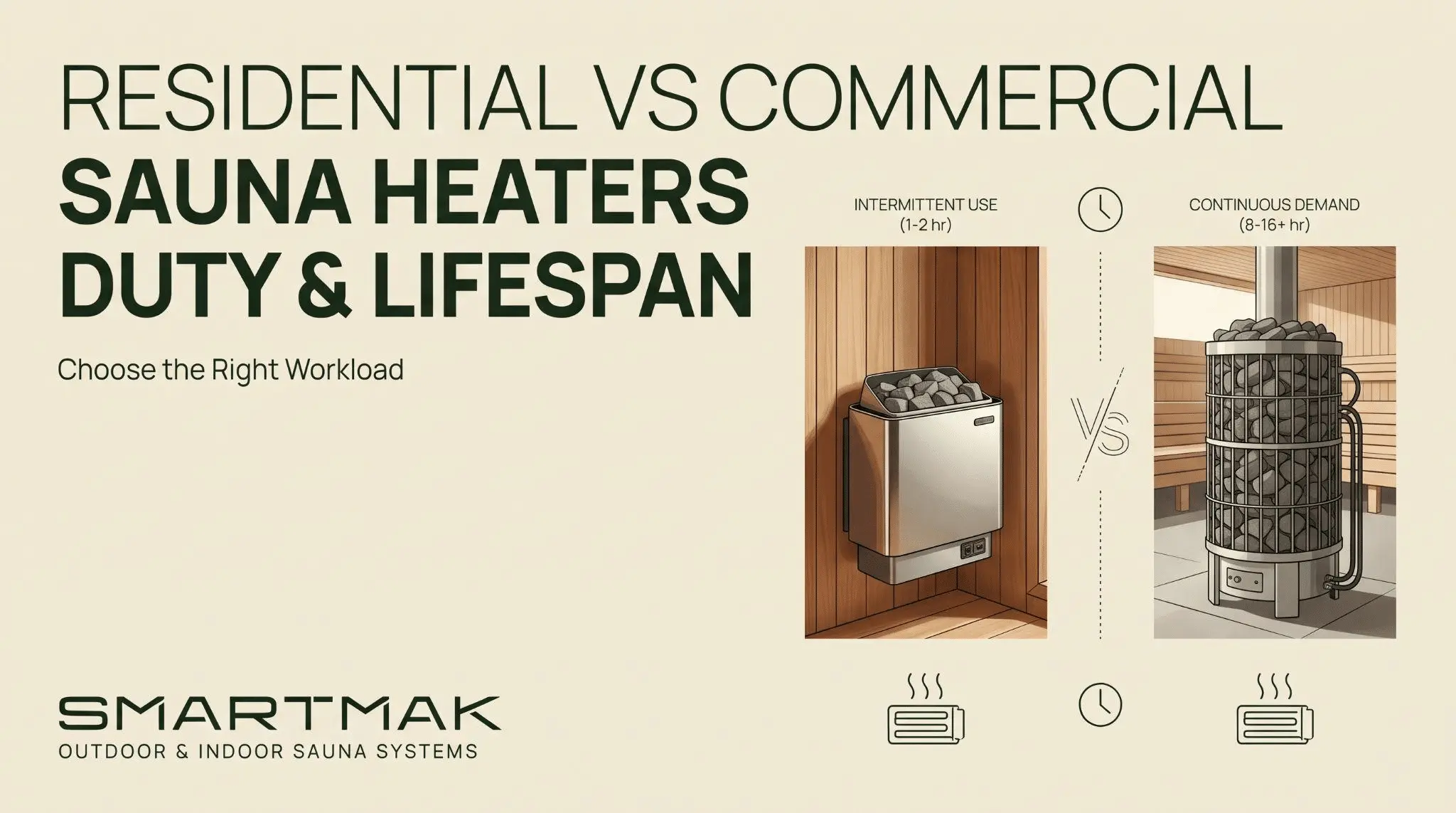
Operating schedules determine how long a sauna heater will last, regardless of its classification. Household sessions are intermittent, with the heater turned on for 45 to 60 minutes to warm up, bathing time of 1 to 2 hours, and then the heater is turned off. Once cooled, the heater chassis, stones, and timber are to be cooled completely before the next usage.
Sustained demand is for shared facilities. Cabins are kept at target temperature for 8-16 hours a day in health clubs, day spas, and public bathhouses. The frequent changing of guests by opening the doors brings cool air in, and bathers pour water onto the stones one after another.
In the hospitality industry, even within the industry, there are different specifications based on the usage model:
- Privately booked Hotel Saunas:If individual guests are booking a sauna in their room or an outdoor cabin for two hours at a time with “cool down” periods between sessions, the workload is closer to that of a household sauna.
- Constant-use Public Spas:A commercial-community complex such as a busier public spa or gym sauna that operates from morning to night demands commercial-use architecture that can be thermally recovered on a constant basis.
1.2 Separate Operating Hours from Heating-Element Duty Cycle
Three different time measurements must be differentiated when specifying equipment:
- Opening Hours:The time of the day during which guests may use the sauna.
- Heater-Enabled Time:The time the controller is on, including warm-up time in the morning.
- Heating-Element Energized Time:The total amount of time (usually in minutes or hours) during which the tubular elements are energized (drawing electrical current) and producing heat.
These are used by the engineers to calculate the duty cycle of the heating element (the proportion of the observed time for which it was energized):
Heating-Element Duty Cycle (%) = (Heating-Element Energized Time ÷ Observed Period) × 100
The duty cycle tends to be 100% during warm-up. When the cabin is set to a set point, the thermostat alternates the duty cycle of the elements, reducing its duty cycle to approximately 30%-50% in a well-insulated room or increasing its duty cycle above 75% when traffic levels are high.
Most importantly, cycling with a thermostat will not qualify the device for long-term commercial use. Domestic heaters that are wired internally and with thermal cut-offs and timers that comply with safety standards like IEC/EN 60335-2-53 or UL 875 are rated for all-day use when unattended, but not for commercial use.
1.3 Create a Basic Usage Profile
For a custom sauna project, buyers should keep track of operating days, number of heating sessions per day, peak sessions, periods of heating down, door openings, water usage, and temperature recovery time between sessions before comparing the various models of heaters. The following table provides examples of use scenarios that contrast with the overall residential or commercial limits:
Planning Variable | Scenario A: Occasional / Private Slot | Scenario B: Moderate Shared Amenity | Scenario C: High-Turnover Public Spa |
Typical Environment | Home sauna, private hotel villa | Boutique hotel spa, apartment gym | Commercial fitness club, public bathhouse |
Operating Schedule | 2–4 days/week; 2–3 hrs/session | 5–7 days/week; 4–8 hrs/day | 7 days/week; 10–16+ hrs/day |
Shutdown & Cool-Down | Full cool-down after each session | Overnight and midday off-peak shutdown | Overnight shutdown only |
Door & Water Activity | Low door traffic; light water ladling | Moderate traffic; periodic water use | Frequent door openings; heavy water use |
Recovery Requirement | Standard initial warm-up only | Moderate recovery during evening peaks | Rapid recovery across continuous rushes |

2. Compare Heat Recovery, Approved Operation and Service Access
2.1 Match Heater Output to the Actual Cabin
Calculating the effective thermal volume using the selected heater’s sizing instructions is important to ensure that the heater output is enough for the cabin. Since heat loss can also occur through glass, doors, windows, stones, or tiles that are exposed, it’s important to consider these factors. For every square meter of uninsulated glazing or masonry, most manufacturers will call for 1.0 to 1.5 m3 to be added to the room volume calculated.
If the kilowatt output is inadequate, warm-up times will be longer, and the heating elements will spend more time in a high duty cycle due to opening the door, which will cause element fatigue. It is important to understand that there is no correlation between how powerful the heater is and it being better for performance and longevity. This is because an oversized heater heats up the upper air sensor too quickly, shutting off the elements before the sauna stones have absorbed enough heat. This results in short-cycling relays, poor steam production, and tripped high-limit safety switches.
2.2 Check the Complete Heater and Control System
Commercial readiness will be based on a complete system of the heater and control unit (contactor box, compatible digital controller, temperature sensors, over-temperature protection devices, and heater chassis).
The operating durations, timer settings, and intended applications are covered in model-specific documentation, in accordance with UL 875 or IEC/EN 60335-2-53:
- Domestic Systems:These are usually limited to 1-6 hours of uninterrupted running by a built-in or digital timer, after which they automatically switch off.
- Commercial Systems:Certified for 12, 18, or 24 hours of operation in combination with heavy-duty external contactor panels and approved supervision or remote interlocks.
A domestic system that is bypassed without a timer or reset repeatedly is not a valid commercial upgrade. In home control panels, the warranty is voided if the built-in timer is bypassed or if staff reset the panel at regular intervals. Unanticipated repercussions include:
- Loss of Electrical Safety Certification
- Lapse In Facility Insurance
- Strain on Home Wiring and Relays
2.3 Evaluate Maintainability Alongside Heating Performance
Good maintenance means better uptime. It’s important to consider accessibility of the components:
- Component Architecture:Replaceable element assemblies, separate air channels to keep heavy stones from bending red-hot elements, external relay boxes placed outside the hot room to remove from heat and moisture.
- Service Windows:Assess if heating elements can be replaced or stones can be restacked from the top or front of the chassis without removing the chassis, and if so, can be done during a facility’s overnight closure.
3. Evaluate Service Life by Components & Maintenance
3.1 Differentiate between Heater Life and Component Replacement
The costs of the facility should be divided into the costs of the service life of the heater body and replacement of consumable components. Chassis that are made from a corrosion-resistant stainless steel may last for years without proper maintenance, but sauna stones, mechanical contactors, sensors, and heating elements are wear items that need to be replaced periodically.
The longevity of the warranty does not guarantee the life of equipment. Buyers may often notice that the warranties of residential saunas are longer compared to commercial saunas. This is because commercial saunas generally run much longer than residential ones. Warranties don’t cover consumable stones or stones that are damaged by improper use.
3.2 Identify Conditions That Can Increase Wear
Even though heaters wear out faster under poor operating conditions:
- Extended Heating Demand:Insufficient kW output, inadequate cabin insulation, and heat loss will cause elements to run at a high percentage of their capacity.
- Restricted Airflow from Stones:Electric saunas work on the principle of natural airflow moving from the bottom inlet air and passing through the rocks. With the passage of time, volcanic stones break down and fall down. Heat is trapped when the stones are badly broken down or become compacted, leading to overheating, warping, and failure of the metal sheaths.
- Water Practices and Environment:Pouring chlorinated pool water, salt water, or unauthorized essential oils on stones will corrode metal sheaths and stainless baffles. Use of the heater outside the range of moisture exposure or ambient conditions specified in the manual also compromises electrical terminals.
3.3 Use Operating Records to Plan Maintenance
Simple operating logs assist in the planning of maintenance before a breakdown:
- Monitor Performance Changes:Record warm-up time, recovery time after peak activities, and frequency of high-limit thermal trips per week. If the warm-up or recovery is slow, then the heating element is likely to have failed, or the electrical phase has dropped.
- Schedule Inspections by Usage Intensity:In busy saunas, inspect, wash, and restack stones every 300 to 500 hours, while in residential saunas, inspect, wash, and restack stones once a year, following the manufacturer’s guidelines.
- Separate Routine Care from Qualified Repairs:Staff can safely inspect stones and clean air intakes while the breaker is locked out, but earth-leakage trips, insulation-resistance testing, and element/repair replacement will require a qualified electrician.
4. Specify the Heater Within a Custom Sauna Project
4.1 Use a Smartmak Outdoor Barrel Sauna as a Configuration Example
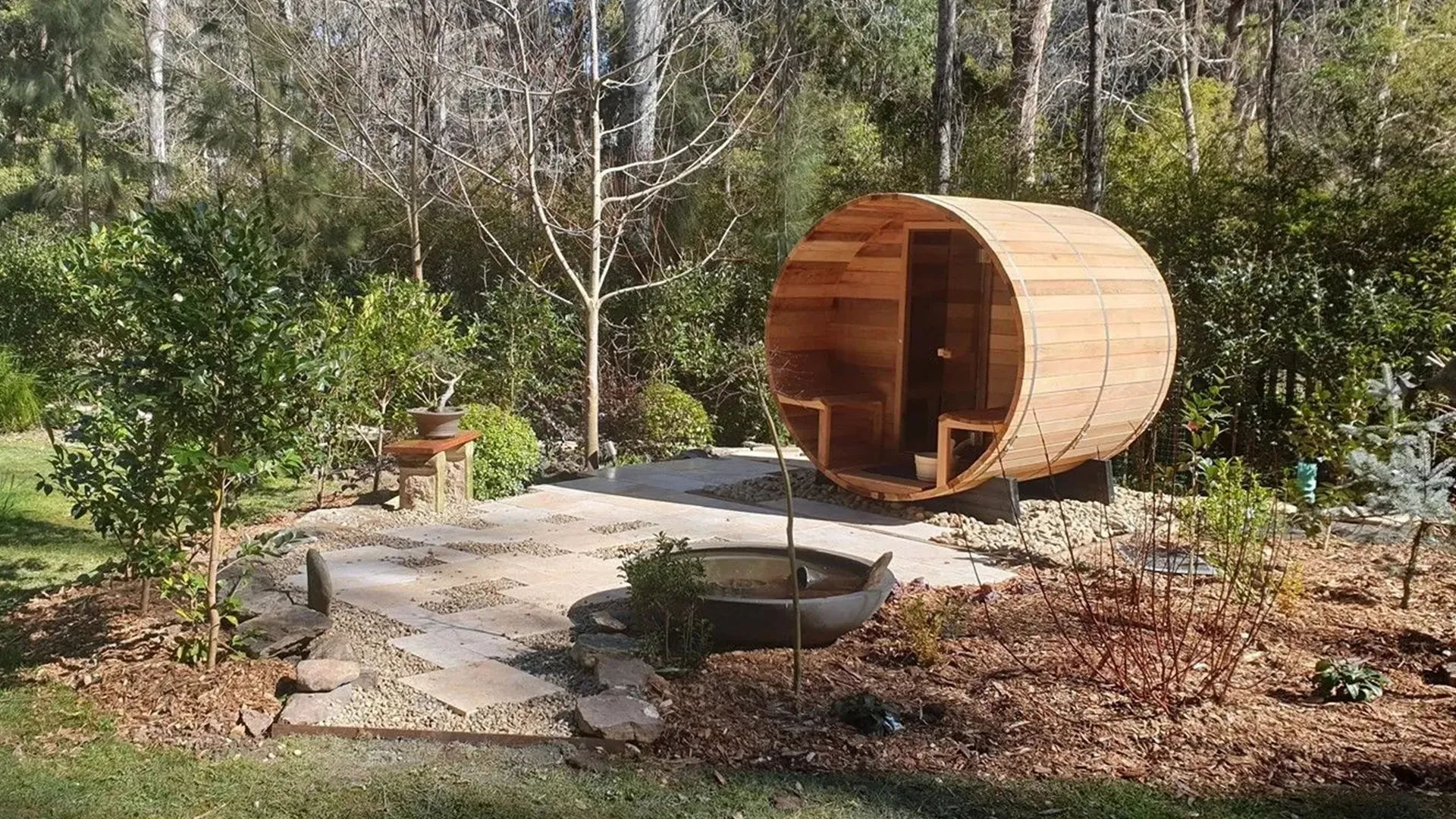
If the heaters are being purchased as a complete package with the prefabricated cabin, the buyer will need to look at the cabin structure and the heater assembly separately. The Smartmak Outdoor Barrel Sauna SH1824 is a complete sauna cabin, provided by sauna manufacturer Smartmak, for your outdoor hospitality and residence projects.
Based on the published product specifications, the Smartmak SH1824 Outdoor Barrel Sauna is listed for applications in hotels as an electric heater with a power rating of 6KW. A listed hotel application, however, does not necessarily dictate the operating time or commercial duty of the heater supplied. If a 6 kW electric heater is used for a private hotel chalet for a couple of hours every day, it is ok, but if the same cabin is used as a shared chalet in a resort pool area for 12 hours a day, the heater and control system must be certified for commercial duty.
4.2 Separate Published Specifications from Unverified Performance
Any B2B procurement is based on documented heater information and published product information. The public listing for the Smartmak SH1824 (electric heating, 6 kW power) does not guarantee an unstated heater brand, continuous duty rating, recovery time, or guaranteed element service life.
If no specific heater manuals are available on a general cabin page, the following are four general selection criteria to check with the heater supplier before ordering:
- Safety Certification:Check that the 6 kW heater and controller are residential or commercial/public certified (IEC/EN 60335-2-53 or UL 875).
- Timer and Control Limits:Review the maximum continuous operating timer window prior to automatic shut-off, and if a contactor box is required, make sure that it is external.
- Thermal Sizing:Ensure that 6 kW is appropriate for the glass door area, barrel cabin volume, and local winter ambient temperatures.
- Spare Parts Support:Request part numbers and availability for spare parts for Heating Element/Element Thermal Cut-Off/Thermal Sensor.
4.3 Compare Ownership Cost for Distributors and Facility Buyers
When it comes to TCO, distributors and facility operators should not just consider the initial price of the stone; they should also consider the installation of the electrical system, the energy costs, stone and element maintenance and servicing, and the availability of spare parts.
Choosing a more affordable residential heater is often a poor choice in a gym or hotel spa, where usage is high. Operators lose guest satisfaction when elements burn out too soon, electricians are called out of hours, or they lose guests to the sauna on weekends.
Conclusion
Residential and commercial sauna heaters need to be equipped to meet the demands of the day, allow for the recommended operating time, match thermal requirements for the sauna, and provide maintenance access. Commercial suitability is not determined by kilowatt output or generic product labels, but rather by the documented heater and control configuration and should be verified with the actual operating schedule with the specific buyer.
For an individual hotel/hospitality project, such as a custom Smartmak SH1824 Outdoor Barrel Sauna configuration, please consult with Smartmak to verify that the heater documentation can be confirmed and that the entire package of the sauna cabin is customized to the operational requirements of your facility.
FAQ
- What heater details should buyers check in a custom sauna package?
For a buyer, it’s important for them to check the overall model of the heater they are purchasing using the manual and nameplate data instead of just checking the operating power. Look for certifications for safety and standards. Also look out for maximum timer run time, public use or domestic use approval, voltage and phase requirements, stone capacity, and how easily the parts are available for the elements and sensors.
- When should heating elements be replaced instead of the whole heater?
Replace heating elements when the heater body and electrical housing are structurally sound and uncorroded, but when warm-up times become longer or when an electrician observes that one or more elements have low insulation resistance (IR) or when IR is seen to be open. Replace the entire heater if the chassis is too heavily rusted or warped, the internal wiring terminals are damaged by heat, replacement parts are no longer available, or the facility’s schedule surpasses the heater’s certified duty rating.
- Can a residential sauna heater be used in a hotel or gym?
It will vary according to the operating schedule, local building codes, and the certified instructions of the heater. In a private hotel suite or bookable cabin, subject to the local electrical code of practice and the manufacturer’s instructions, a heater which has been rated as ‘residential’ may be used within the timer limits as part of a short booking period, provided there are adequate cool-down periods between bookings. If the heater is used in a commercial gym that is operating continuously for 6-16 hours a day, or a shared hotel spa, the heater should not be used, as the thermal clearances, timer cycles and warranty are not designed for commercial use.
- What is the difference between residential and commercial sauna heaters?
Residential heaters are designed and tested for short run-time timers (usually 1 to 6 hours) and small controls for intermittent use in the house. Commercial sauna heaters are designed and tested for extended daily use (12 to 24 hours, with external contactor boxes and programmable controllers), are made with heavy-duty heating elements, have more capacity for the stones, and provide better access for regular maintenance of the parts.