Introduction
Did you know that a high-quality infrared sauna costs about $0.32 for a 45-minute session? It is considering the average U.S. electricity rates. That’s cheaper than everyday spending, like buying a cup of coffee. The major positive change is happening worldwide. Wellness seekers are looking for high-quality and relaxing tools for use at home. Even though consumers want to buy a sauna setup for home, they typically have the following queries:
- Impact of Sauna Addition on Electricity Bill
- Long-Term Operating Costs
- Environmental Impact of the Equipment
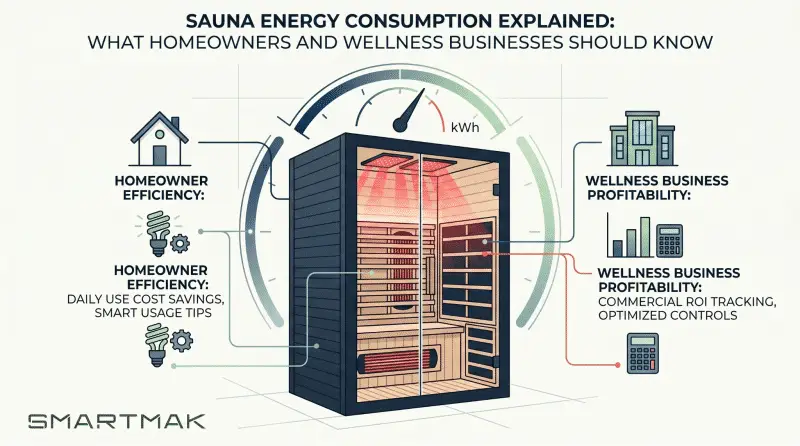
Through in-depth analysis, we can find an approximate energy consumed by various types of saunas. However, the values may vary based on heater wattage, insulation of the heated cabin, and local utility rates. The switch to modern technologies like infrared saunas has brought down the costs significantly.
This guide will provide an in-depth analysis of sauna energy consumption that homeowners and wellness businesses would find useful.
How Much Electricity Does a Home Sauna Actually Use?
Understanding Sauna Power Consumption
The total amount of electricity that a sauna consumes is determined using the power rating of the sauna heater in kilowatts. Then it’s multiplied by the amount of time it is turned on, which includes the time to warm up the room.
When we first turn on the sauna, it takes a little while for the heaters to increase the temperature from atmospheric conditions to sauna suitable conditions. Usually, it takes around 30 minutes to reach that state. During this time, the heater is working at its maximum capacity. Once the room has reached the required temperature, the heaters start to turn ON and OFF as per requirement. Effectively it’s running at 50% of its full capacity.
The consumption is also heavily reliant on the size and type of the sauna. Here are three examples:
- Small One-Person Sauna:Depending on its build quality, they typically consume around 1.5kW of power. They are very convenient as they can be plugged in a regular 110V power socket.
- Family Size Sauna (2-4 Person):If we choose the modern infrared sauna models, they need around 3kW of power. In the case of a classic sauna, where hot rocks and water are used, the requirement goes to 4.5kW and even 7.5kW.
- Large Commercial Setup (6-8 Person):For large commercial setups with large spaces, the requirements go up drastically. They need around 8 to 9kW of power. It needs a dedicated power supply to ensure safety.
Table 1: Energy Consumption Comparison with 1-Hour Session
Appliance | Typical Consumption (kWh) |
Infrared Sauna (1-2 Person) | 1.5 – 3.0 |
Electric Clothes Dryer (1 load) | 2.0 – 5.0 |
Traditional Steam Sauna | 6.0 – 9.0 |
Central Air Conditioning (1 hour) | 3.0 – 5.0 |
Electric Water Heater (Daily) | 12.0 – 15.0 |
Differences Between Sauna Types and Their Energy Efficiency
Infrared Saunas
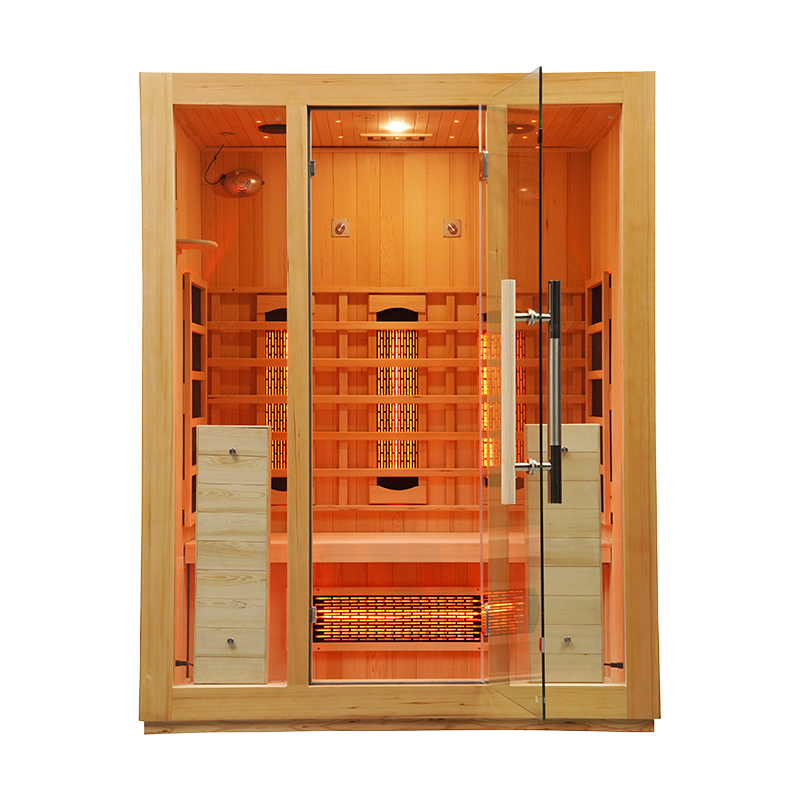
Saunas that use Infrared (IR) technology use radiative heat transfer. It means that they don’t need to warm up the entire cabin air to start their therapeutic effects. They run at a lower temperature, around 120 F. It results in lower power consumption of around 60% in comparison to the traditional version. They also reach their desired temperature faster than others, taking just 15 minutes. These consume around 1 to 3 kWh per session.
Traditional Steam Saunas
The traditional steam saunas use convective heat transfer to initiate the wellness impact. It requires the room temperature to reach up to 195 F. The bigger the room, the more time it takes to heat up the entire air. Moreover, they also require sudden bursts of steam heat (löyly). It requires keeping the sauna stone heated up. These consume around 3 to 9 kWh per session.
Environmental Factors
Placement of the sauna also has an impact on its power consumption. A sauna placed outside in winter will have higher power consumption. Typically, they require up to 30% more power to operate in comparison to the indoor version. The energy requirements may change with the season for outdoor versions.
Advance Innovations
Some researchers are attempting to create saunas that capture heat from the solar thermal collectors. Then store that heat in specialized tanks. Their main aim is to reach 100 C without any requirement for external electrical energy.
What Factors Can Increase or Reduce Sauna Electricity Costs?
Frequency of Use and Session Duration
To keep the electricity bill low it’s important to build ideal habits and usage scenarios. It means limiting your sessions to 10 to 15 minutes. Longer periods mean higher power consumption. To reap in the health benefits and to avoid overheating, the recommended session time is ideal. Moreover, developing a daily habit of using a sauna also helps. If we ensure that the door remains closed after each daily session we actually leave some heat behind until the next within the 24-hour window.
One of the biggest wastages of electricity is letting the sauna run for too long before getting in. Aim to enter the sauna as soon as it reaches the required temperature.
Sauna Construction and Insulation Quality
The sauna’s build quality also has an impact on its performance. The insulation material is the key factor to keep the heat contained and improve efficiency. An airtight room with super insulation can cut the power consumption by 20%.
As we know, wood and glass are the major players in heat retention. Let’s analyze some of the key material that buyers should look for in their personal or commercial sauna:
- Canadian Hemlock: For most cases, it is the primary choice for an indoor sauna. They have high density with consistent wood grain patterns. It stays solid and does not change its dimensions even after cyclic thermal stresses.
- Canadian Red Cedar: The wood is naturally resistant to decay and fungus. It also has ideal heat resistance, which allows it to keep the trapped heat inside, lowering power use. It’s also safe, as someone touching the outside of the wood will not feel any heat, preventing burns.
- Sealing: The sealing material is key to ensure that there is no hot air escaping the enclosure. This means using 8mm double-pane tempered glass and strong magnetic seals around the doors.
- Advanced Coating: Some modern findings under experiments reveal a method to decrease the wood swelling phenomenon. The wood surface is coated with a graphene-based coating. It reduces the wood’s swelling by 60% when exposed to moisture. The result is an increase in the operational life of the sauna.
Smart Heating and Energy-Saving Features
Modern saunas come with smart features that effectively help manage electricity use. Using technology as WiFi and App controls, enables users to turn on the sauna exactly at the time when needed. It is pre-heated to the desired temperature, reducing the idle time significantly. It also allows users to program the time to turn off the system once the time has passed or after the end of business hours. It prevents any potential leakages of electricity, especially in commercial settings.

Why Energy Efficiency Matters for Wellness Businesses and Distributors
Growing Demand for Cost-Effective Wellness Equipment
Whether you are an owner of a commercial spa or gym, you need to determine the ROI before making an investment. The speed at which you recover your investment depends on the energy bills. In such cases, infrared saunas are the best investment as they often pay for themselves in less than three months for facilities with a good consumer base.
Alongside the energy bill, business owners also need to consider how space-efficient a sauna unit is. A high-capacity unit designed for 4 to 6 people is highly valuable as it allows them to utilize a single sauna for multiple users. Another important factor to consider in business, especially in wellness facilities, is the consumer mindset. A boutique fitness user often asks for:
- Sustainability of Facility
- Low-EMF Certified Products
How Smartmak Supports Energy-Conscious Sauna Projects
Smartmak has extensive experience in making wellness products. It has allowed them to improve the performance of their heaters and cabins. Particularly, their insulation fabrication holds heat exceptionally well. Their focus is on safety and efficiency through the use of an infrared system that utilizes a carbon fiber heating panel. They are engineered to produce almost no electromagnetic radiation. These panes consistently emit levels below 3mG (milligauss).
As a major player in the international market, Smartmak serves partners across six continents. They offer their business partners OEM/ODM solutions. All of their products come with detailed guides and excellent after-sales support.

Tips for Reducing Home Sauna Electricity Usage
Tips for Reducing Home Sauna Electricity Usage
- Off-peak Hours:The best technique is to schedule the sauna time during off-peak hours. Many utility companies charge less when the electricity demand is lower on the grid. It can turn into massive savings.
- Temperature Setting:Avoid setting the temperature too high. Keep it at the level most comfortable for your wellness sessions. It allows more energy efficient operation with controlled heat production.
- Involve Others: Try to group sessions together if there are multiple users, especially in a domestic application.
Improve Heat Retention
There are techniques that users can apply to improve the heat retention capability, irrespective of the build. They can place the sauna in a controlled temperature environment. A finished basement is an ideal location as it is warmer than other rooms. Then ensure that you keep the doors tightly closed during the sessions to prevent hot air from escaping the enclosure.
Choose the Right Sauna for Your Needs
One of the key decisions is to make sure that you buy a sauna that suits your requirements. An oversized sauna may require extra heat while the therapeutic effects remain the same. Always stay focused on the goal. The main target is to remove toxins from the body while keeping the monthly costs as low as possible. Opt for full-spectrum infrared models that are the most efficient choice for home use.

Conclusion
Modern saunas are highly energy efficient. Especially if we consider the infrared technology. Combining them with an intelligent control system and IoT devices, the whole setup produces a lower energy bill per month when compared to daily use appliances like air conditioners, dishwashers or clothes dryers.
For businesses, consider saunas with professional commercial-grade insulation. They will maximize your ROI and improve the satisfaction rating of customers. Ensure routine maintenance, strategic location placement, and proper power supply to maximize your profits. To ensure that you have the ideal power consumption, explore the full range offered by Smartmak. They offer Full-Spectrum Infrared Saunas and Outdoor Barrel Steam Rooms with modern features that improve thermal performance. Visit their website or contact them for detailed information on all their products:
- Phone: +86 15551183989
- Email: [email protected]
- Website: https://www.smartmak.com/
FAQ
Q: Do home saunas use a lot of electricity compared to other appliances?
If you use a sauna around three times a week, then it will consume less than your daily run appliances. For instance, a dishwasher or clothes dryer will consume more energy for the same one-week time period.
Q: How much does it cost to run a sauna per month?
Considering the energy costs from 2026 studies, using a sauna 3 times a week can vary in terms of cost depending on the type. A traditional sauna would cost a minimum of $18 per month, while an infrared model costs as low as $4 per month.
Q: Are infrared saunas more energy efficient than traditional saunas?
infrared uses less energy in comparison to traditional saunas. They provide heat that directly penetrates the body without needing the complete air to heat up and homogenize. They typically are up to 70% more efficient than traditional saunas.
Q: How many watts does a typical home sauna use?
Depending on the type of sauna, the power consumption can change. An IR-based sauna will use 1 to 3.5kW. While traditional saunas will require a specialized power outlet to consume 3 to 9kW of power.
Q: Does sauna size affect electricity consumption?
A larger sauna size takes more time to reach the optimal temperature for therapeutic effects. However, no matter how large, infrared saunas will always consume less power than traditional saunas.